Problems with the sources
“I am acutely aware that, so far, I have not given a description of the Spartan system of education; we know too little about the subject even to imagine being able to do this successfully.”
So writes Jean Ducat in chapter 3 of his book Spartan Education: Youth & Society in the Classical Period.1 Yet if you do a little research on the internet, it won’t take you long to find lots of detailed information about how it all worked. How can this be?
Well, essentially, the problem is that descriptions of the Spartan system mostly come from sources written long after the Classical period, and may actually be describing something that evolved when Sparta was already well into its decline. Imagine writing a story about a school in the 19th Century based on information about a 21st Century Comprehensive School - computers instead of quill pens, counselling instead of corporal punishment and science instead of lots and lots of Latin and Greek!
Of course, the process of evolution was likely to have been slower than that of education in modern times and it was certainly true that other Greeks were aware of the unusual nature of the Spartan educational system long before the period in which I have set my story. Therefore for the purposes of my book I have supposed that, broadly speaking, the system in the 5th Century BCE was the one described by these later sources; that boys left their homes at the age of seven and lived communally, under the immediate supervision of older boys, with a ‘paidonomos’ appointed by the state in overall control.
A Broad Education
History has its fashions like anything else, and there has been a move away from viewing Spartan education as purely militaristic but rather as a more balanced social training. This makes sense. If nothing else, there is only so much drill you can do over a period of perhaps fifteen years, before you stop learning anything useful.
So there were lessons in writing and basic arithmetic, and singing and formal dancing had an important role in creating a sense of community and cohesion. Beyond that, it is hard to know. It is generally thought that they didn’t do weapon combat in the early years but fighting with sticks is such a part of every child’s instinctive behaviour that I can’t believe it wasn’t at least a game that they played. So I put that in. There were ball games too, apparently, but I resisted the temptation of including one in the book. I’d have had to have made up some rules, as few have come down to us!
Olympic Sports
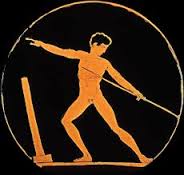
Sparta had a lot of success in the early Olympic competitions before the events became dominated by professionals with specialised diets. I have supposed that there was a designated training area and that wrestling was done by all the boys. Specialised events such as javelin and long jump were probably not so generally practised and it is chance that allows my hero, Lykos, to have lessons in the javelin. Throwing or stabbing with hoplite combat weapons would not have required great specialist skill, just strength.
Survival Techniques
The other aspect of Spartan education was self-reliance. According to ancient sources, Spartan boys were kept hungry and encouraged to steal to supplement their diet. If they were caught they were severely punished. The practicalities of this has always worried me. For one thing, surely, you would want your future warriors to be strong and well-nourished? To keep them permanently half-starved doesn’t seem the most sensible plan. And how far could they travel to steal? The local farms would only have so much edible produce easily available, and then only at particular times of the year. No one is suggesting they went off into town to steal from the markets.
I have gone my own way on this, imagining that there were periods set aside from their general routine when boys were sent off into the countryside to fend for themselves, like a boy-scout expedition. Potentially dangerous, of course, but without too many significant risks, and offering just the sort of opportunity for self-reliance that was apparently prized by the Spartans.
I also invented the game with the strips of cloth and the helmet. It is the sort of team game that they might have played to build group identity and ingenuity, and, to be honest, it suited the story. (In the back of my mind I think there was something similar with strips of cloth in the ancient world. If anyone can throw any light on this, please get in touch!)
The Limitations of the System
All in all, Spartan education was relatively balanced, but still very narrow by modern standards. Even the Spartans themselves seem to have been aware that more was needed as there is evidence that wealthier parents gave their sons additional training.
But what of the outside world? That was the problem, of course, for the whole Spartan system. It created warriors, it created a cohesive system for the elite, but it was hermetically sealed. Once Spartans crossed their borders, the limitations of their world-view were exposed. Then they were too often blunt and unsympathetic, as well as corrupt.
If you want to delve a little deeper into Spartan education and the mentality it produced, try my next blog - Shame and Success in Spartan Culture.
And if you have any thoughts on this one, please get in touch!
1Ducat, Jean, et al. Spartan education: Youth and Society in the Classical Period, Classical Press of Wales, 2006, JSTOR, https://doi.org/10.2307/j.ctvvn9g2.14. Accessed 23 June 2026